
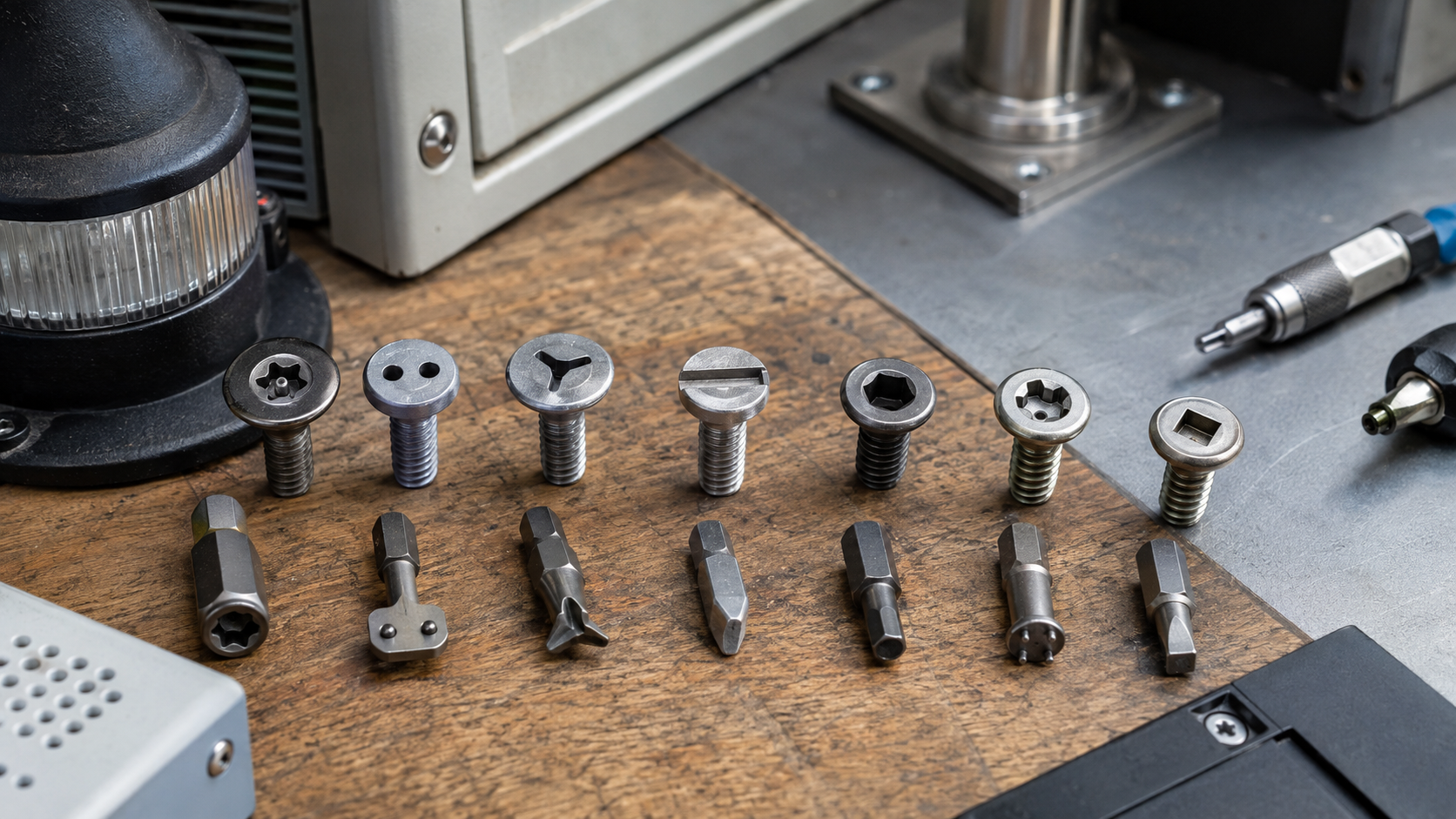
7 Types of Tamper-Proof Screws and Where to Use Them
You have likely attempted to open something with a regular screwdriver and encountered a screw head that simply does not resemble anything in your set. Six points instead of a cross. A small pin in the middle sticking up. Two oval slots instead of a single line. Those are not mistakes in production – it’s intentional. These odd-shaped fasteners are used by manufacturers to deter unauthorized access to the inside of the product, and once you know about them, you will notice them all over the place.
“Tamper-proof” is the wrong word, but everyone uses it anyway
Before we discuss the specific types of screws, we want to clarify something: nothing on this list is truly tamper-proof. A determined individual with the correct bit, a drill, or enough patience wielding pliers can defeat all of these drives. The industry term for what we’re describing is more technically accurate: tamper-resistant. These screws aren’t designed to be permanently unbeatable – they’re designed to increase the cost of entry. A teenager with a butter knife isn’t getting into a vending machine secured with spanner screws. A casual thief isn’t unscrewing your license plate with a flathead if it’s a one-way screw. The goal is deterrence, not an unbreakable vault. Once you understand this, you’ll see why these screws show up on cheap plastic enclosures just as much as pricey electronics – the manufacturer isn’t trying to stop a determined attacker, just an opportunistic one.
Ok, now that we’ve got that out of the way, here are the seven you’re most likely to encounter, what they look like, and where you’ll encounter them.
1. Pin-in-Torx (Security Torx)
The standard Torx is the six-point star drive that people have used to loosen screws. The Pin-in-Torx, also known as Security Torx, includes that same six-point star with an added little pin straight out of the middle. This pin means a regular Torx bit will not fit properly – it will hit the pin before the star shape, so it just spins or cams out.
Pin-in-Torx can be located on computer tower cases, power tool housings, electrical panels, EV charging station enclosures, and outdoor security boxes. Basically, wherever a manufacturer needs a technician to open the unit but does not wish for a curious user to pop the case off with something from the kitchen drawer. It is also popular on playground equipment and public-facing electronics where vandalism is a concern.
To remove one, you need a bit with a matching center hole drilled into the tip, so the pin has somewhere to go. A Post Torx Driver is specifically built for this – the hollow center lets the bit slide over the pin and seat fully into the star pattern, which is the only way you get proper torque without stripping the head. This might be the most common security fastener in home electronics repair, so if you’re building out a bit set, this is the one to prioritize.
2. Pentalobe
Pentalobe screws are distinctive in that they have a five-lobed, flower-like pattern, unlike the more common slot or Phillips and the star-shaped Torx. They were first used in Apple’s MacBook line in 2009.
Nearly a decade and a half later they’re still with us and have proliferated widely across laptops, phones, and tablets. Apple has long since broken the seal on the use of pentalobe, but even if the drive is less surprising than a new Radiohead album, it’s no less annoying to encounter. In effect, pentalobe is a hardware padlock, preventing unauthorized entry to your device without the key which, naturally, is held by an authorized service centre (or you, if you own the right bit).
You’ll find pentalobe screws on the bottom case of laptops (including Apple’s MacBook Air and Pro) and near the charging port on the back of phones (every iPhone since the 4). They’re surprisingly ornamental, and easily mistakable for a Phillips. Then the driver starts slipping. A feeling immediately followed by the thought: oh no, it’s one of those.
3. Tri-wing
Tri-wing screws are shaped like a Y with three slots that are angled and meet at the center. They look like a three-bladed propeller. This type of screw is probably familiar to you even if you haven’t actually used one before. Most people remember this screw from Nintendo game consoles and cartridges. It has remained the standard drive for many handheld and console applications because it is rare enough to keep out the average joe tinkerer. What you may not realize is that the tri-wing head was never intended for toys – it was developed for military and aerospace applications in the mid-20th century, where the shape was intended to provide a drive that resisted cam-out under high torque and in the presence of severe vibration. Consumer electronics borrowed it later for the tamper resistance.
Outside of game consoles, you would encounter tri-wing screws on a few electronic toys and some niche appliances. If you’re a parent trying to change the batteries in a child’s toy, and you come across one of these, that is why your standard screwdriver set isn’t working.
4. Spanner screws (snake-eyes)
Spanner screws, known as snake-eyes due to their appearance, feature two small oval or round holes right next to each other on the head instead of a single slot or star. No ridge, no star point, no groove for a blade to grab – just two holes that require two matched pins to turn.
This is the drive you’ve likely encountered without being aware of its name. Public restroom stall partitions, vending machines, parking meters, and theater or stadium seating seem to be particularly partial to spanner screws. If you live in an apartment building, the fire extinguisher cabinet or a piece of common-area furniture may use them as well. Apartment dwellers and commuters encounter this screw type vastly more frequently than someone working on a detached house, because so much public and shared infrastructure is held together with it.
Spanner screws show up in these applications for the simple reason that the fastener needs to survive constant public access without inviting disassembly. A two-pin driver is rare enough that most folks just can’t remove the panel, even if they would like to.
5. One-way screws
These specialized screws work by allowing a screwdriver to dig into the grooves as it’s twisted in a clockwise direction. However, when you try to turn the screw in a counterclockwise direction, the screwdriver will slip out of the grooves, which prevents removal.
The design of the one-way screw makes it ideal for attaching items that you don’t want people to be able to easily remove. It is commonly used for public restroom partitions, hoses and accessories for restaurants, and in some instances, electrical outlets.
However, the one-way screw isn’t the strongest tamper-proof fastener around. It is known to strip easily with enough force, meaning they may not be able to protect your property from someone with a stronger-than-average intent to steal.
If you ever need to remove a one-way screw legitimately, the usual trick is a pair of pliers gripping the head at an angle, or a specialty extractor bit made for exactly this purpose. It’s one of the few entries on this list where “just buy the matching bit” isn’t really the answer, because the whole design is built around not having a clean reverse-drive option.
6. Breakaway or shear bolts
Breakaway bolts, also known as shear bolts, operate on a totally different principle from everything else in the list. They don’t act based on the shape of the drive at all. Instead, they operate based on torque. The bolt is actually designed to shear (break off) cleanly once a specific torque is exceeded during the tightening process. Then you’re left with a smooth, even rounded end, which could be almost impossible to unscrew.
This renders them a one-time fastener. One chance to get the correct installation, and it will then be nearly impossible to remove it without destroying the fastener. That’s by design. They are used in anti-theft door hinges so that the hinge pin can’t be easily unscrewed and the door removed. Security window screens and gates have used them for the same reason. Some anti-theft wheel lug systems also use a shear bolt variant, so that a thief can’t just unbolt a wheel with a normal socket.
If you’re doing home security upgrades – reinforcing a door, adding a security screen, locking down an outdoor gate – breakaway bolts are generally the strongest option on this list, precisely because there is no bit or trick that gets them out short of destructive removal.
7. Proprietary and hybrid security drives
Not every tamper-resistant screw fits into those neat categories; in fact, many are a hybrid of the above designs. A hex head may have an off-center pin, a Torx star may have an extra lobe, a slot may have an internal ridge, etc. In some cases, there are no screwdriver bits available that fit the head, and any bit that would fit the head would be extremely difficult to manufacture without reverse-engineering the screw itself. You’ll see these on some appliance casings, certain bike lock housings, and higher-end electrical equipment, as the manufacturer wants tighter control over who can service the unit.
The practical takeaway for DIY repairs
The pattern is the same across all seven types: Figure out the drive shape first, then try the bits until you find the best match, then hope you’ve selected a bit made from steel hard enough to get you through the job. A lot of those cheap security bit sets are just little pieces of soft metal that grind to nothing in short order, and that’s actually worse than having the wrong bit, because now you’ve messed up the screw on top of everything else.
If you’re going to do this more than once in a blue moon, S2 steel at the very least (that’s the kind sometimes labeled ‘hardest tool steel’ at reputable shops) is your new best friend. Torx or Security Torx drives in particular are easily wrecked by subpar bits – the whole reason they exist, going back to their introduction by Camcar Textron in 1967, was to increase resistance to cam-out compared to slotted and Phillips heads. A soft or wrong-size bit negates that advantage completely.
Around a typical home, keep an eye out for these fasteners on security screen doors, outdoor sensor lights, gate hinges, kids’ electronics, appliance cases, and bike locks. These are all spots where a manufacturer wants to prevent both theft and casual disassembly, and it’s exactly where a five-minute repair turns into an hour-long standoff if you don’t have the right bit on hand.
Keep a set, save yourself the headache
Certainly, no screw is unbeatable, and that’s by design – the point isn’t to prevent you from getting in forever. The goal is just to ensure you don’t get in by accident. Most multi-bit security sets can handle any pin-in-Torx, pentalobe, tri-wing, or spanner drive you come across at home or the office. If you skip the investment, you’ll be stuck using a pair of pliers, a drill, or worse, taking a trip to the repair shop for a fix that would’ve only taken a few minutes.